Question 1
1.a.
A Markov chain is a stochastic process where the future state depends only on the current state, not on the past states.1
Let
- : discount level of policyholder after years
- where: - State 0: no discount (0%) - State 1: 15% discount - State 2: 25% discount - State 3: 40% discount
- representing years
represents the premium discount status at the end of year
The Markov property holds because next year’s discount depends only on the current year’s discount and whether a claim was made.
1.b.
From Rangkuman:
- Transition probability is the probability of transitioning from state to state in one time step.
- Transition matrix contains all in matrix form.
Given:
Then:
- From state 0 (no discount): with no claim → state 1; with claim → state 0
- From state 1 (15%): with no claim → state 2; with claim → state 0
- From state 2 (25%): with no claim → state 3; with claim → state 1
- From state 3 (40%): with no claim → state 3; with claim → state 2
Transition Matrix:
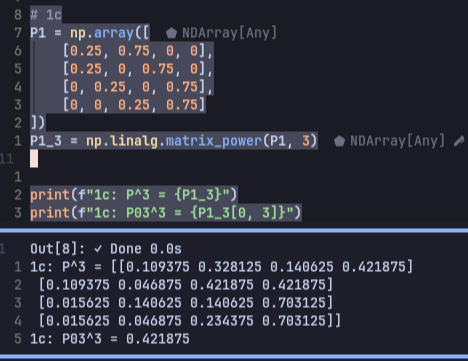
1.c.
We need:
From Chapman-Kolmogorov:
Using Python to compute :
1.d.
We need:
This is a one-step transition from state 3 to state 2.
represents the probability of transitioning from state to state in one time step.1
From the transition matrix in 1.b.:
Question 2
Given:
- State space:
- Transition matrix:
- Initial distribution:
2.a.
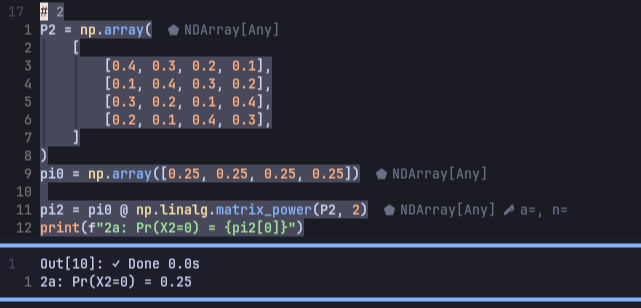
From Chapman-Kolmogorov:
- The distribution at time is:
We need the probability of being in state 0 at time 2 ()
2.b.
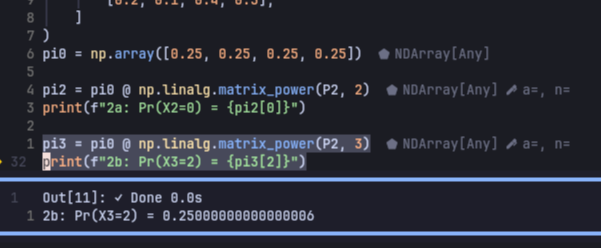
We need the probability of being in state 2 at time 3 ()
Question 3
Given transition matrix:
We need to classify which states are transient and which are recurrent. (See Recurrent vs Transient)
By definition:
State is accessible from state if for some .
- Two states communicate if they are mutually accessible.
- Communication satisfies: reflexive, symmetric, transitive (equivalence relation).
- States that communicate form a class.
- Classes are either identical or disjoint.
- A chain is irreducible if there is only one class.
First Step Analysis:
- From state 0: Can go to states 0, 1, 2
- From state 1: Can go to states 0, 1, 2
- From state 2: Can go to states 3, 4, 5
- From state 3: Can go to states 0, 1, 2, 5
- From state 4: Can go to state 2
- From state 5: Can only go to state 5 (absorbing)
So:
- {0, 1}:
- 0 → 1 (via )
- 1 → 0 (via )
- {2, 3, 4}:
- 2 → 3 → 4 → 2 forms a cycle
- {5}:
- State 5 is absorbing ()
- It’s a singleton class.
Therefore:
- Transient states: 0, 1, 2, 3, 4
- Recurrent states: 5
Question 4
Given:
- Demand distribution: , , , ,
- Policy: with and
So:
- If inventory after demand ≤ s (= 1), order up to S (= 4)
- If inventory after demand > s (= 1), no order
4.a.
= Probability of transitioning from state 4 to state 1.
Analysis
- Demand = 0 → Inventory = 4 → Since 4 > s = 1, no order → Next state = 4
- Demand = 1 → Inventory = 3 → Since 3 > 1, no order → Next state = 3
- Demand = 2 → Inventory = 2 → Since 2 > 1, no order → Next state = 2
- Demand = 3 → Inventory = 1 → Since 1 ≤ s, order to 4 → Order 3 units → Next state = 4
- Demand = 4 → Inventory = 0 → Since 0 ≤ s, order to 4 → Order 4 units → Next state = 4
So:
- From state 4, the next states possible are: 4, 3, 2 (all > 1)
- There is no scenario where the next state = 1
4.b.
= Probability of transitioning from state 0 to state 4.
Analysis
- Demand = 0 → Inventory = 0 → Since 0 ≤ s = 1, order to S = 4 → Order 4 units → Next state = 4
- Demand = 1 → Inventory = 0 → Since 0 ≤ s, order to 4 → Next state = 4
- Demand = 2 → Inventory = 0 → Since 0 ≤ s, order to 4 → Next state = 4
- Demand = 3 → Inventory = 0 → Since 0 ≤ s, order to 4 → Next state = 4
- Demand = 4 → Inventory = 0 → Since 0 ≤ s, order to 4 → Next state = 4
All scenarios lead to state 4. So,